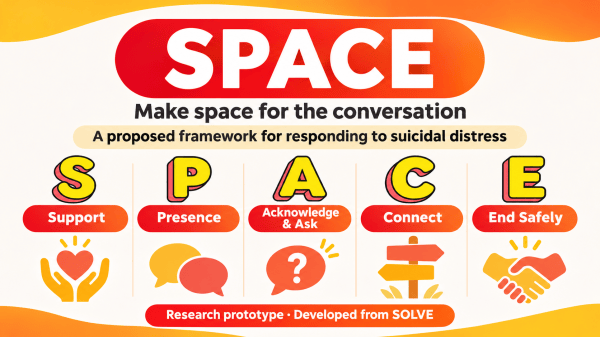
SOLVE is changing - SPACE is the next development of SOLVE: a brief conversational resource for responding to suicidal distress, with its name, components and usefulness still to be tested.
From SOLVE to SPACE: making room for the first conversation

Suicide prevention, occupational health, evidence synthesis and public engagement.
SOLVE is changing - SPACE is the next development of SOLVE: a brief conversational resource for responding to suicidal distress, with its name, components and usefulness still to be tested.
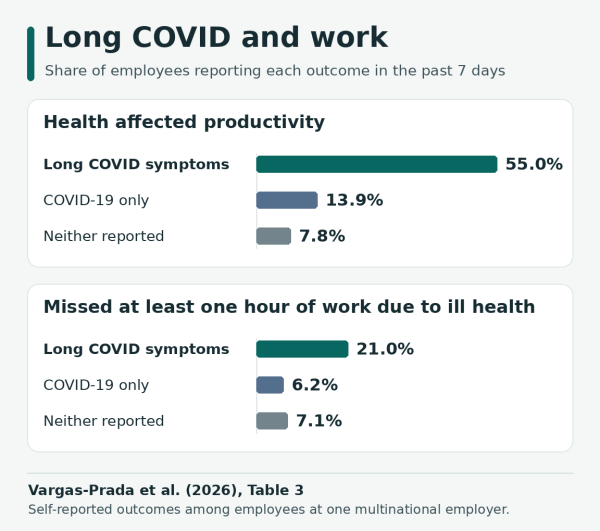
Our study of employees in the UK, India and Brazil found that Long COVID symptoms were associated with difficulties at work and more sickness absence.

In many ways, this is one of the most complex topics I ever discuss when it comes to suicide prevention. Training and years of experience leads me to always say that disclosure of suicidality must be taken seriously, and that support pathways can and should be identified to support the individual at risk. However, it is also true that such feelings can be utilised to manipulate a situation and be involved in domestic abuse, controlling behaviours, or even attempts to circumvent legal consequences. Being suicidal does not automatically excuse current or past behaviour, but it does demand intervention and recognition. The practical task is to help someone live through a moment when they cannot see a way forward. That deserves patience and serious support. It also requires us to protect other people’s ability to leave, seek safety or be heard. A response that makes one person’s silence the condition of another person’s survival has left too much responsibility in the wrong place.
For a comedian, gig work is fairly literal. The audience sees the minutes on stage but built around that performance is hours of writing, travelling, agonising, chasing bookings and, at least for most non-superstar comedians, working out the cost of performing. Applause and laughter is amazing, but it remains surprisingly difficult to use at the... Continue Reading →
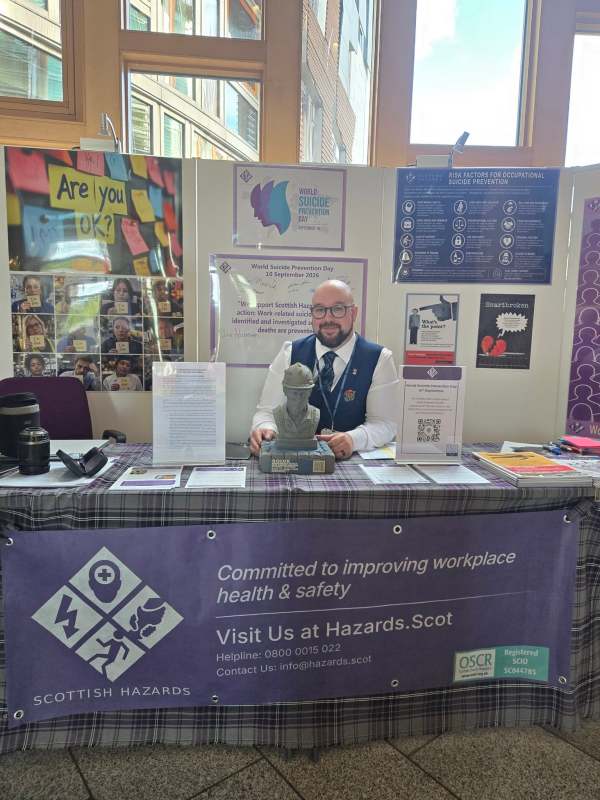
We encourage people to ask for help, but what happens when they do? On World Suicide Prevention Day, I explore Scotland’s support pathways and propose research into who receives appropriate care, whether it helps, and what happens to those whose needs remain unmet. A referral is not the same as receiving care. Suicide prevention cannot end with the first conversation.

I am Dr Simon H. Walker, a researcher at the University of Glasgow working across occupational health, suicide prevention, workplace mental health, and evidence synthesis. My work focuses on how workplaces, institutions, and communities can better recognise and respond to distress before crisis point. I am particularly interested in suicide prevention beyond traditional clinical settings,... Continue Reading →

Surveillance technologies are rapidly transforming mental health care, promising safety but delivering complex ethical challenges. Drawing on Griffiths et al. (2024) and Foucault’s concept of the panopticon, this reflection considers whether “smart wards” enhance care or merely extend institutional control. In an age of data-driven vigilance, the question is not how much more we can see, but whether we still understand what we are looking at.

Over the last few months, I’ve sent out multiple carefully written, relevant op-eds to major publications I’ve previously worked with—on suicide prevention, AI, and Scottish heritage. Not a single response. This piece explores the emotional and professional impact of that silence. It reflects on gatekeeping, merit vs. luck, and how editorial ghosting can chip away at self-worth. I draw parallels to stand-up comedy—another space where access often depends more on contacts than quality. Despite the silence, I keep writing. This is a message to others still pitching into the void: I see you. You’re not alone. Keep going.
Thanks for listening to my talk, pleasure and honour to be in such esteemed company. Please get in touch to discuss and collaborate - Simon.Walker@Glasgow.ac.uk

This year I am delighted to be giving The Goodall Lecture 2023 on June 19th at the Royal College of Physicians and Surgeons of Glasgow on Thomas Annan, Public Health, and Infection Control in Victorian Glasgow. Find out more about Thomas Annan here - and book tickets for the event

