

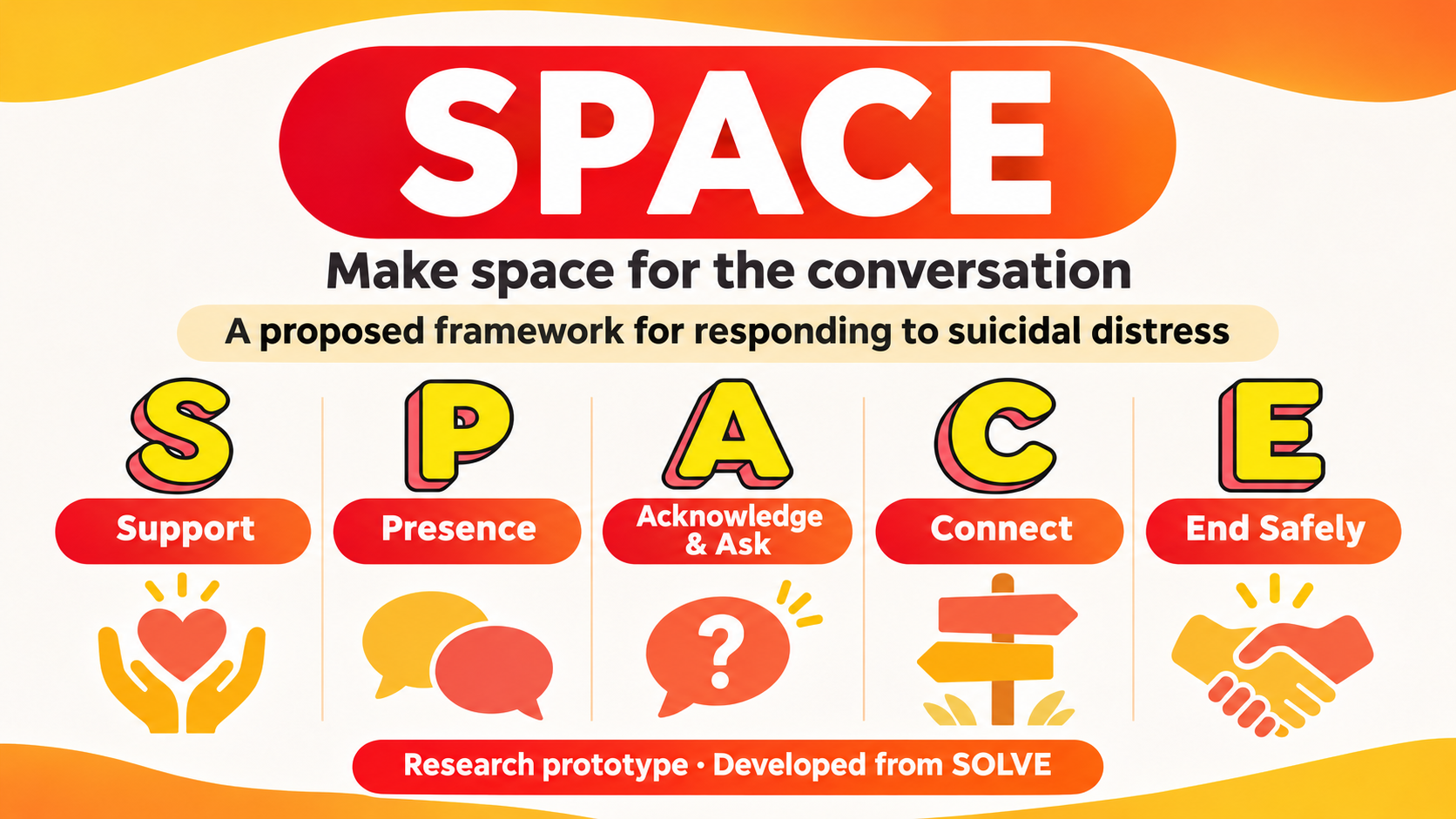
Sometimes someone offers a suggestion that makes you look again at the thing you have been trying to explain. My friend and colleague Jim Roughan did that recently with a deceptively simple idea: what if SOLVE became SPACE?
I have been developing SOLVE as a brief resource for those moments when someone discloses suicidal distress and the person listening is unsure how to respond. The intention has always been to support a compassionate first conversation, particularly in workplace and community settings where the listener may have no specialist mental health role.
Jim pointed out something fundamental that there was a problem with the name. SOLVE can sound like a promise, or an instruction, to fix what is happening. That is a considerable burden to place on someone who may already be frightened of saying the wrong thing. SPACE may describe the purpose more honestly.
In 15 words Jim clarified something that I had been nagging at me for ages without me realising it – he wrote:
“You don’t need to solve suicide. You need to make SPACE to talk about it.“
And everything changed.
This is an account of a developing research idea. SOLVE, and its proposed development as SPACE, remain unvalidated prototypes. The components below are candidates for research and consultation, not a clinical protocol or a ready-to-use crisis response guide.
Where SOLVE began
I first wrote about SOLVE in November 2024, following a difficult personal experience of disclosure and feeling unheard. That post was raw. The question behind the resource was practical: what could help someone respond when another person trusts them with something painful?
That question still matters to me. We encourage people to talk about distress, but the conversation has another participant: the person hearing it. They may care deeply and still feel uncertain about what they can offer, where their responsibilities lie, or how to help someone reach further support.
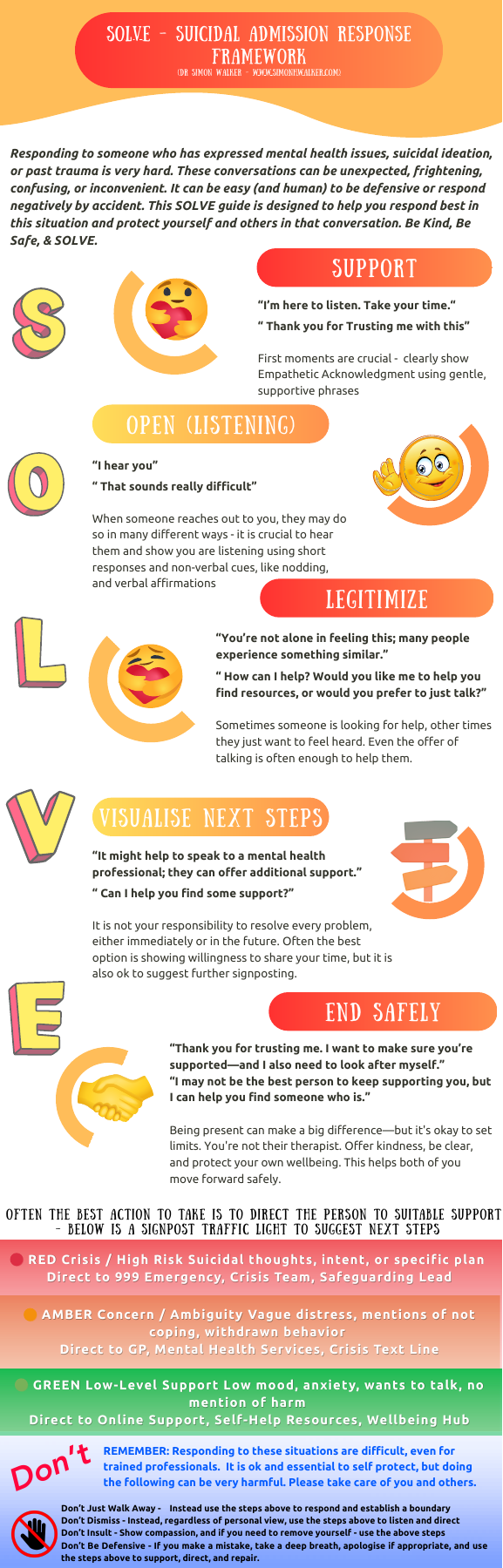
SOLVE was an attempt to give that moment some structure. Its content made room for listening, acknowledging distress, considering next steps and recognising boundaries. Yet the name could suggest that the listener was being handed a problem they were expected to resolve.
What changes with SPACE
Jim’s suggestion brought that tension into focus. SPACE gives us a different starting point: making room for a person to speak and be heard, with attention to support, safety and what happens next.
That does not mean that listening is always enough, or that making space removes the need for action. Any useful resource must be clear about its limits, appropriate support and escalation. The development question is whether we can make the first response easier to understand without making it sound simpler than it is.
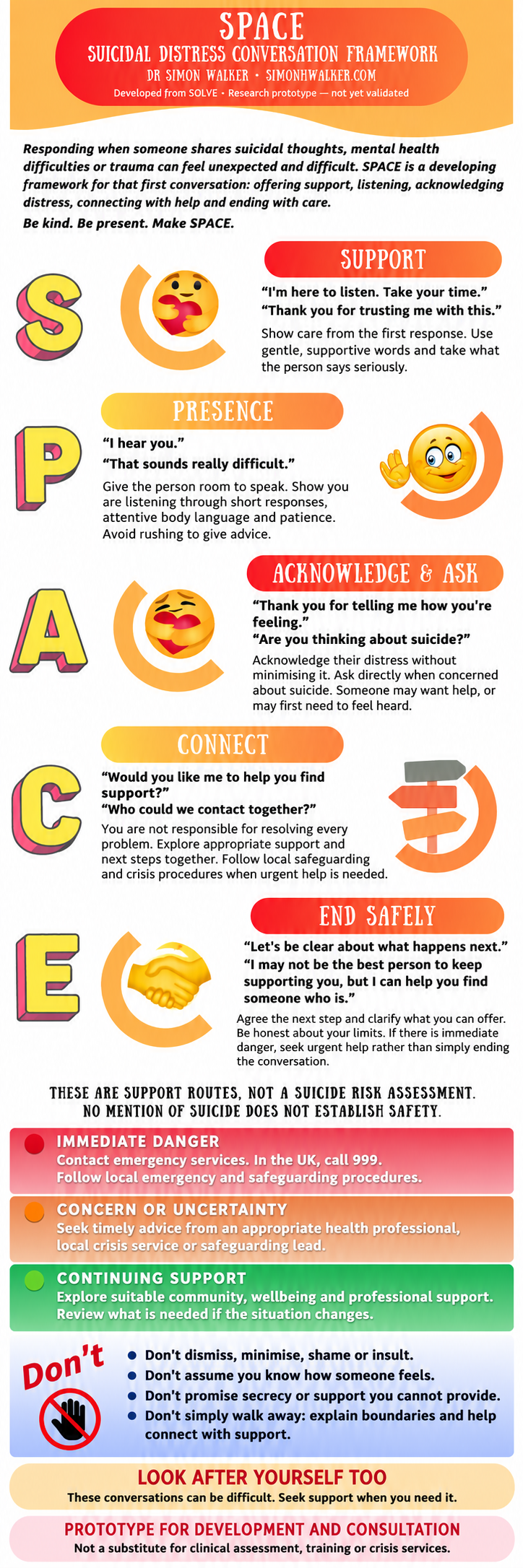
The working components we are considering are:
S — Support. The initial offer of support and connection.
P — Presence. Being alongside someone and giving attention to what they are saying.
A — Acknowledge and Ask. Recognising distress while retaining an explicit place for asking about what is happening, including suicidal thoughts.
C — Connect. Considering next steps and connections with appropriate support.
E — End Safely. Paying attention to how a conversation ends, what follows and the boundaries of the responder’s role.
Those words are provisional. In particular, Acknowledge, Ask, and Acknowledge and Ask deserve examination through the development and Delphi process. A neat acronym must not decide the content before we have tested the assumptions behind it.
There is considerable continuity with SOLVE. Support, listening, acknowledgement, next steps and a careful ending were already central to the idea. SPACE offers a way to reconsider how we describe and organise them.
The connection with Time Space Compassion
My first concern was whether we were moving too close to something that already exists. Scotland’s Time Space Compassion approach explicitly includes emotional and psychological space: being alongside people, listening on their terms and working through next steps when the time is right. It also addresses accessible environments, safety, connection and boundaries.
There is a useful possible relationship here. SPACE could be a brief conversational resource for non-specialists that gives practical expression to compatible principles at the point of disclosure. That is the position I want to investigate.
It is not enough to declare that the two are different. Time Space Compassion already includes practical examples, and our review needs to examine existing resources carefully. We need to establish whether SPACE would add something useful, where it overlaps with other approaches, and whether the name would clarify or confuse. Compatibility would not amount to endorsement.
An idea that must remain open to change
One of the most useful things about Jim’s suggestion is that it changes the project while it is still being developed. I want that contribution recorded. If we ask people to help shape a resource, there must be room for their input to change more than the wording around the edges. The proposed research programme brings together evidence and resource mapping, lived experience and organisational involvement, professional Delphi consultation, and development of a prototype for feasibility testing. It must first examine whether there is a distinct need and whether this is an appropriate response to it.
Agreement that the framework sounds sensible would not establish that it works. A feasibility study would help examine whether it can be introduced, understood, used and evaluated acceptably and safely. It would not establish that SPACE reduces suicide deaths. The name, components, boundaries and proposed format therefore remain open. Existing suicide prevention training, specialist care, safeguarding procedures and crisis services retain their roles. A short conversational resource cannot stand in for them.
For now, SPACE gives me a clearer way to describe what I am trying to develop: a resource that helps someone make room for a difficult disclosure, understand the limits of their role and consider how the conversation connects with further support. I would welcome thoughts on that change, particularly from people with lived experience and those who encounter disclosures through their work or community roles. Does SPACE communicate the intended purpose more clearly? What does it leave unclear? Those are questions worth answering before the name becomes fixed.
Finding support in Scotland
- Immediate danger. If someone’s life is at immediate risk, call 999 or go to A&E. NHS inform emergency guidance
- Urgent mental health support. If you can’t get help from your usual service, call NHS 24 on 111 and choose the mental health option. NHS inform urgent help
- Samaritans. For free listening support, day or night, call 116 123.
- Breathing Space. Free, confidential listening support for people aged 16 and over in Scotland. NHS 24 service information and opening hours


Leave a Reply