

Understanding suicidal distress and recognising coercion

A crisis can change a person’s sense of what remains possible. The end of a relationship may also mean losing the future they had imagined. A threat to their livelihood may unsettle their sense of who they are. What appears survivable from outside can feel inescapable to the person living through it. That does not make suicide an inevitable response to crisis. It does mean we need to understand more than the event itself. We need to consider the meaning it holds for that person, the circumstances surrounding it and the support available to them.
One influential account, Rory O’Connor and Olivia Kirtley’s integrated motivational–volitional model, proposes a pathway in which experiences of defeat or humiliation can contribute to feeling trapped, and that entrapment can contribute to suicidal thoughts. It also distinguishes the development of those thoughts from the factors involved in acting on them. The model offers a way to understand possible processes; it cannot tell us what a particular person will do. [1]
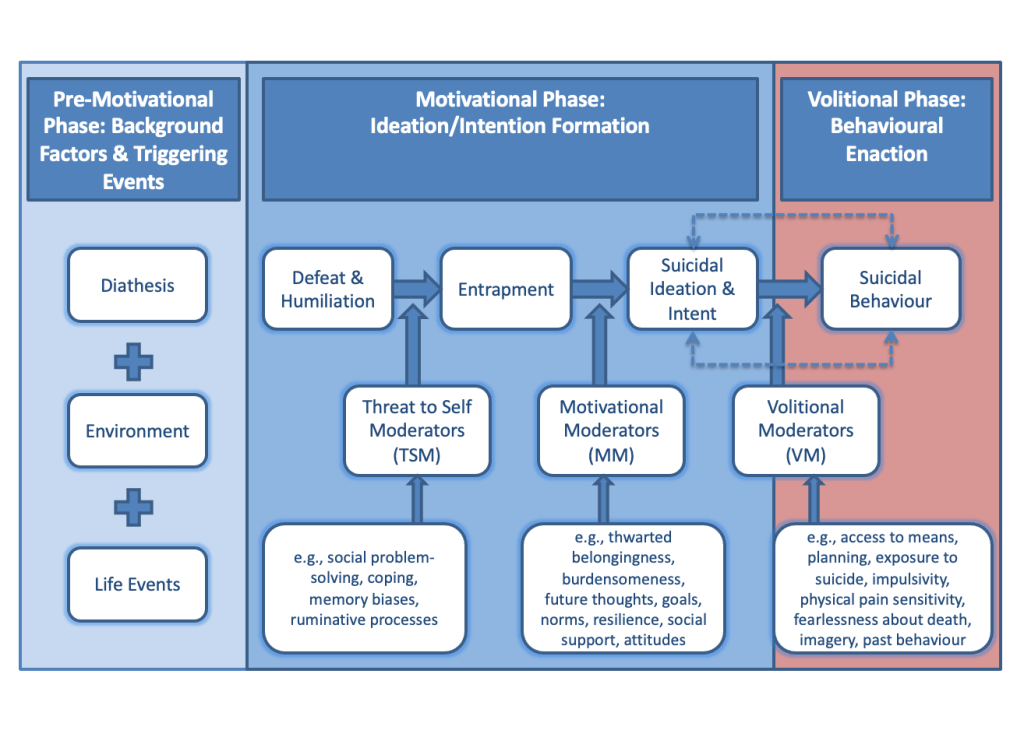
For someone in crisis, the difficulty may be imagining any tolerable life beyond what is happening now. Helping them find that possibility is part of prevention. It need not depend on restoring everything to how it was before.
These questions become particularly uncomfortable when a crisis follows allegations of wrongdoing. Public sympathy can start to resemble a verdict: acknowledging the accused person’s distress is treated as taking their side, while caring about those reporting harm is taken to require indifference towards the accused. Suicidal distress establishes neither guilt nor innocence. Someone falsely accused may become suicidal. Someone who has caused serious harm may also become suicidal. Both need care. The truth of an allegation must be considered through evidence and a fair process, rather than inferred from somebody’s psychological response to it.
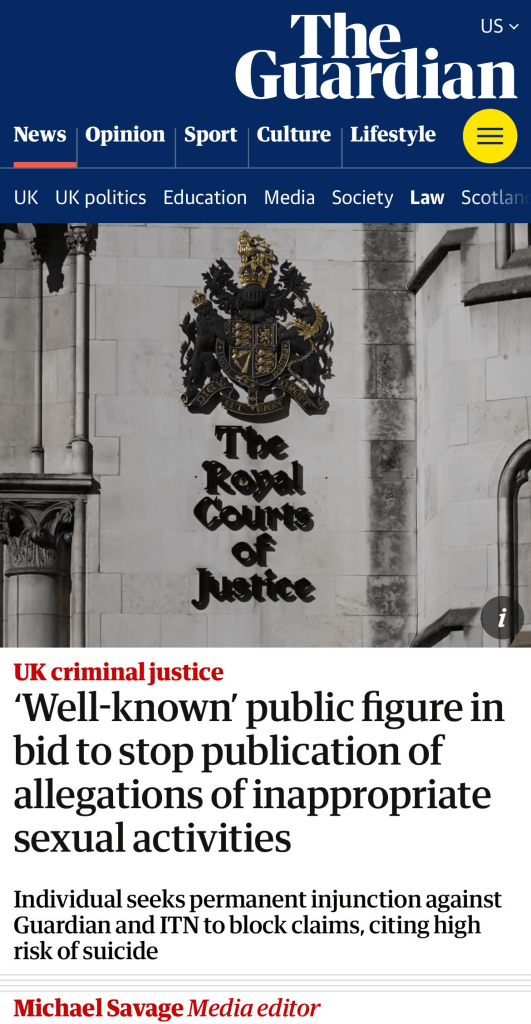
The proceedings in PPT v ITN and Guardian News and Media bring this tension into view. In its public judgement of 9 October 2026, the High Court recorded that the claimant denies the allegations and relies on medical evidence in seeking to prevent publication because of an asserted risk to his life. The media organisations oppose the claim. That judgement concerned anonymity and expressly left the substantive issues for trial. Seeking judicial protection on medical grounds does not, by itself, establish manipulation. [2]
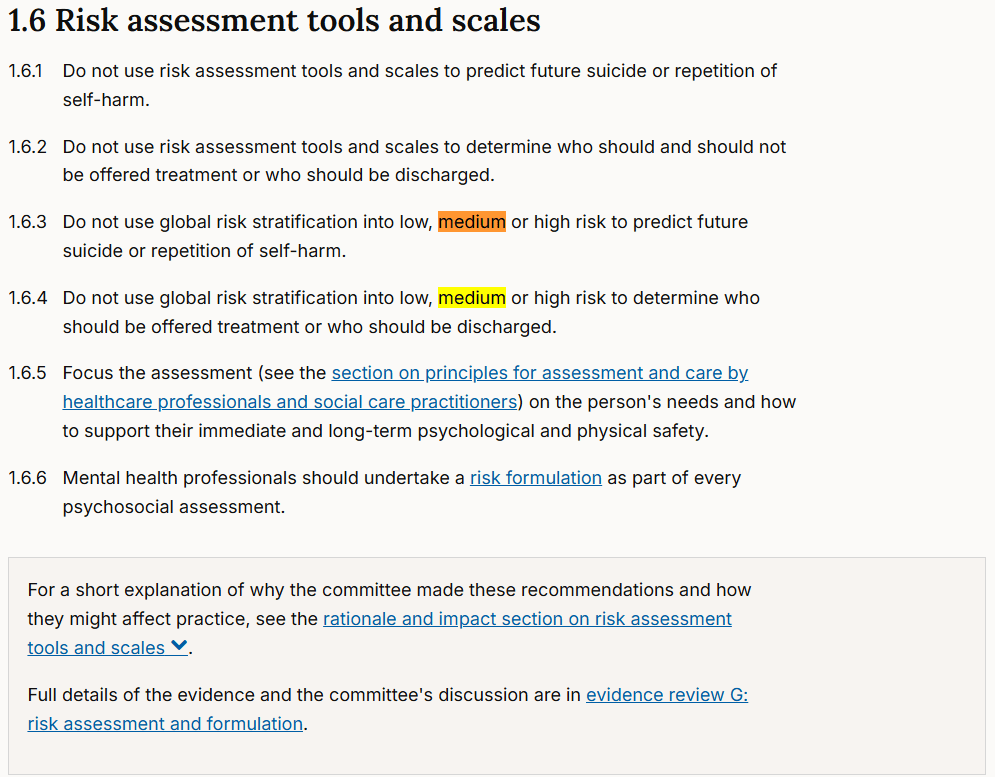
We cannot settle such questions by reading a headline. Nor should we make a person’s entitlement to care depend on whether we approve of them. Prevention has to include people whose behaviour we dislike, as well as people with whom we readily identify. Taking distress seriously also requires care with predictions. NICE’s guidance on self-harm advises against using risk scales or broad categories such as low, medium and high to predict suicide. It recommends attention to the person’s needs and their immediate and longer-term safety. This clinical guidance does not decide a dispute about publication, but it cautions against treating suicide risk as a simple, certain forecast. [3]
For an employer handling a complaint, this should mean considering how an investigation can proceed safely and fairly alongside appropriate support. A crisis may justify changes to timing or arrangements. Those changes should have a clear purpose and be reviewed, with attention to the effects of delay on everyone involved. Otherwise, a temporary response to distress can become an indefinite barrier to examining what happened.
There is, however, a further difficulty. Expressions of suicidal intent can be used to exert pressure on other people. Any serious discussion of crisis needs to acknowledge this without turning suspicion into the default response to someone asking for help. Somebody explaining that a separation has left them frightened and suicidal is not necessarily trying to control their partner. A pattern of insisting that the partner must stay, keep a secret or withdraw a complaint to prevent a death raises a different concern. The context and the demands being made matter.
The Home Office’s statutory guidance for England and Wales explicitly recognises threats of suicide as a possible method of controlling a victim, particularly to prevent them from leaving. That recognition belongs in discussions of coercion. It does not mean that every disclosure of suicidal thoughts is abusive, or that the person making a coercive threat faces no actual danger. [4] Genuine distress and coercive behaviour can coexist. A person may be in considerable pain and still place an intolerable burden on someone else. Acknowledging that burden does not require us to prove that the distress is fabricated. Equally, recognising distress does not remove the need to examine the behaviour and its effects.
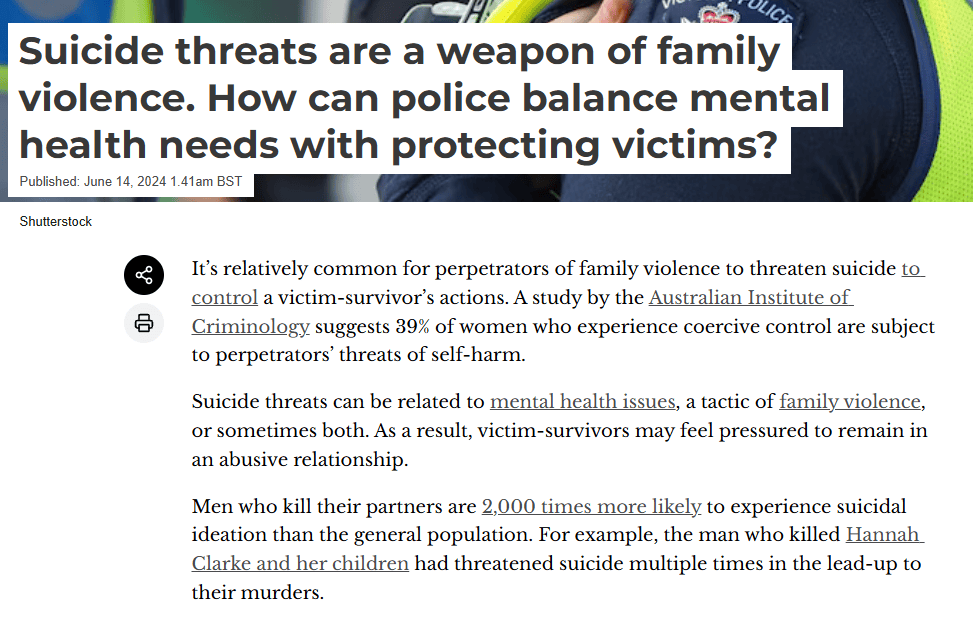
This is why I am wary of the term “weaponised suicide” as the starting point. It can name a real abuse of power, but it can also imply that we already know someone’s motives. Used carelessly, it makes disclosure sound like evidence of dishonesty. People should not have to demonstrate that their distress serves no possible purpose before anyone takes it seriously. Pressure can also come from people around the person in crisis. A family member, colleague or institution may insist that a complainant remain silent because disclosure could have catastrophic consequences. The distressed person may not have made that demand themselves. We need to examine who is applying the pressure, what they are asking for and whose interests disappear from the discussion.
That being said, there is a range of evidence to show that such claims are used in cases of abuse and manipulation. Where coercion is a concern, the response needs to address both safety and the restriction of another person’s freedom. Someone should not be left to assess the sincerity of a suicide threat alone, or made solely responsible for managing the crisis. Involving appropriate mental health support, alongside specialist domestic abuse support where relevant, can help move responsibility beyond the person being pressured. This also requires care with blame. Samaritans’ reporting guidance warns against reducing suicide to a single event or factor. A crisis may be important without providing a complete explanation. Saying that someone who leaves a relationship or reports alleged harm will therefore be responsible for a death makes a claim about causation that cannot simply be assumed. [5]
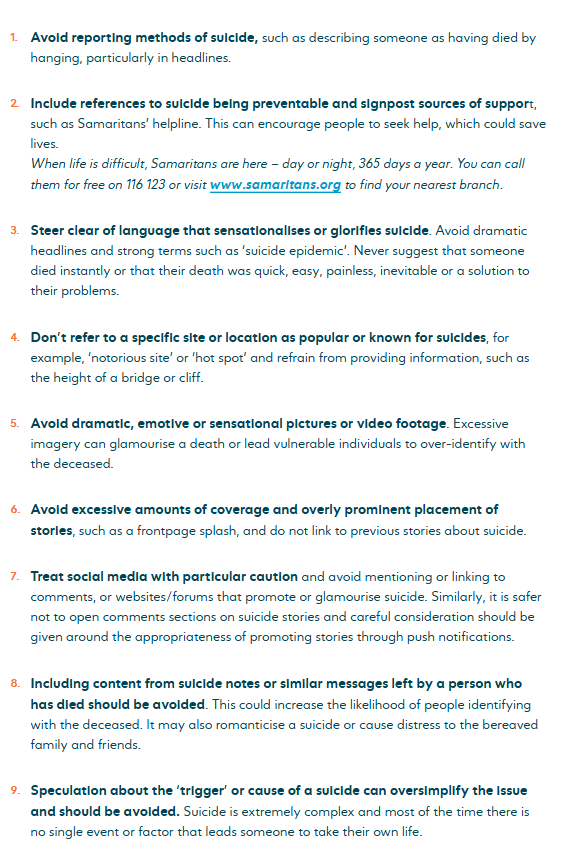
Still that is not a reason to disregard cruelty or abuse. Those actions can cause serious harm and deserve scrutiny. It is a reason to distinguish responsibility for harmful behaviour from automatically assigning responsibility for another person’s suicide to whoever made a decision they found unbearable. The wellbeing of people reporting harm also belongs in this discussion. They should not have to become visibly suicidal themselves before their safety is considered. Nor should their distress be used as an automatic verdict against the person they accuse. Everyone involved needs support, and allegations still require careful examination. Public discussion can make that harder. Reporting matters of public interest carries responsibilities towards those affected by the reporting. Fair scrutiny does not require harassment or speculative naming. It should leave room for the possibility that someone can survive a crisis and build a life afterwards, including where that life involves consequences or unwelcome change.
In many ways, this is one of the most complex topics I ever discuss when it comes to suicide prevention. Training and years of experience leads me to always say that disclosure of suicidality must be taken seriously, and that support pathways can and should be identified to support the individual at risk. However, it is also true that such feelings can be utilised to manipulate a situation and be involved in domestic abuse, controlling behaviours, or even attempts to circumvent legal consequences. Being suicidal does not automatically excuse current or past behaviour, but it does demand intervention and recognition. The practical task is to help someone live through a moment when they cannot see a way forward. That deserves patience and serious support. It also requires us to protect other people’s ability to leave, seek safety or be heard. A response that makes one person’s silence the condition of another person’s survival has left too much responsibility in the wrong place.
If you are struggling, Samaritans offers free support day or night on 116 123.
Sources
[1] O’Connor, R. C. and Kirtley, O. J. (2018). The integrated motivational–volitional model of suicidal behaviour. Philosophical Transactions of the Royal Society B, 373, 20170268. Read source.
[2] PPT v Independent Television News Limited and another [2026] EWHC 2560 (KB), 9 October 2026, especially paragraphs 1 and 8–16. This is the public judgement on anonymity, not a judgement determining the substantive claim. Read source.
[3] NICE. Self-harm: assessment, management and preventing recurrence. NG225, recommendations 1.6.1–1.6.6. Read source.
[4] Home Office (2023). Controlling or coercive behaviour: statutory guidance framework. Applies to England and Wales. Section on perpetrator tactics, under Manipulation. Read source.
[5] Samaritans. 10 top tips for reporting suicide, especially tips 2, 3 and 9. Read source.


Leave a Reply