
We are facing a culling of creative arts, and it terrifies me. Currently, I work as an Occupational Health Researcher and Suicidologist at the University of Glasgow within the School of Health and Wellbeing, but I never aimed to be in medicine. Initially, I trained as a historian. My undergraduate and master’s degrees were based in History and Sociology, and my PhD at Strathclyde began with a focus on medical military history. Midway through that journey, I veered into suicide studies—driven partly, painfully, by my own experiences. But history remained my constant: teaching it, researching it, writing it. I entered academia braced for the brutal job market, yet with a quiet confidence nurtured by students and colleagues who told me I was an excellent lecturer, tutor, and supervisor.
I never got that post—despite applying to over 150. The only offer I received was short-term and precarious, and I turned it down for a safer research position outside history, in the field of occupational health. Four years later, friends and peers still in the humanities face layoffs, closures, and institutional erasure while I watch from the comparatively sheltered terrain of my adopted field.
Watching these fights on my doorstep and in the news, im filled with odd emotions, not relief, but fear, anger, concern, and grief.
A Perfect Storm: The Humanities Under Fire

The crisis isn’t hypothetical—it’s happening now. Canterbury Christ Church University has announced it will stop offering English literature degrees. Once a bastion of literary studies, EngLit courses are retreating across the sector: A-level entries dropped from 83,000 in 2013 to 54,000 in 2023, and humanities enrolments across universities have plummeted from nearly 60% of students in 2003–04 to just 38% in 2021–22 . In England, these declines are being blamed on runaway tuition fees and an insistence on programs that deliver clear, quantifiable returns for the job market, leaving literature, critical thought, and empathy under siege.
A recent survey by the Royal Historical Society clarified how pervasive the damage has been: out of 66 UK history departments surveyed, 39 have implemented staff cuts, and 32 have lost entire degree courses since 2020. Meanwhile, the British Academy warned that subjects like theology, anthropology, and modern languages have been eviscerated, with the hardest hit students being those from disadvantaged backgrounds, further contracting social mobility while fragmenting the academic landscape.
Institutions in Crisis
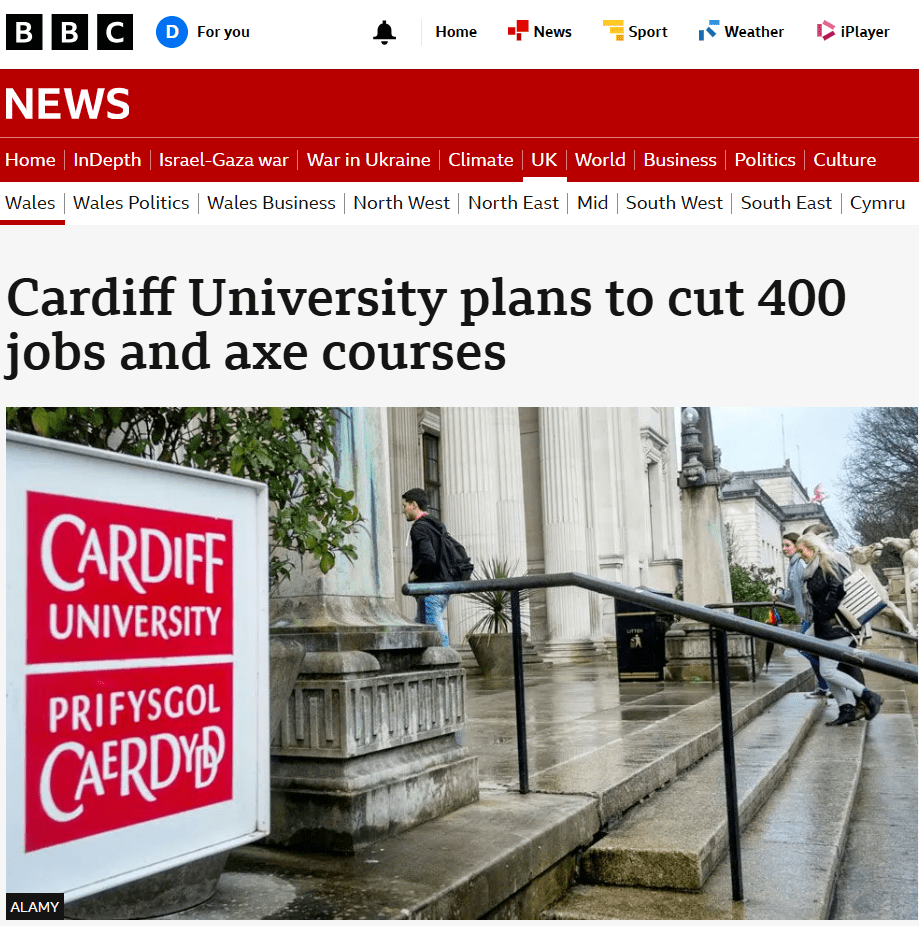
It seems almost every news day seeks to clarify that these cuts are not local anomalies but systemic and brutal amputations across the field. Consider Cardiff University: in January 2025, it revealed a £31 million deficit for 2023–24 and proposed axing about 400 academic roles—razing programs in ancient history, music, modern languages, religion, and theology. The arts and humanities were slated to absorb roughly half of these losses. Elsewhere Kingston University has begun the process of dismantling its Humanities department entirely, including shutting down its respected Centre for Research in Modern European Philosophy in the name of a £20 million savings goal. Another casualty is The University of Sheffield’s Department of Archaeology, which was founded in 1976 and internationally revered, but was suddenly shuttered in early 2025 despite petitions and expert objections.
The Spiral Deepens: National Decline and Its Consequences

Beyond individual institutions, the whole higher education system is bleeding. Dame Julia Black, outgoing president of the British Academy, has warned of a “vicious spiral”:
Cuts to humanities courses → fewer graduates → fewer teachers → fewer A‑level students → more closures
She also claimed that the sector is in danger of creating “cold spots” where some students must travel over 200 km to find programs in their subjects. In response, she calls for urgent, radical reform, scrapping the Office for Students, launching a cross‑party commission, and redefining the purpose of universities in the UK’s social and economic future. The Financial Times captures the enormity of the crisis: universities are in the grip of an “academic recession,” with collapsing domestic tuition value, rising costs, visa changes curbing international enrolment, and an exodus of non-lucrative subjects leaving the academic base hollowed out . In Scotland, the University of Dundee’s plan to slash 700 staff, among them almost the entire humanities faculty, demonstrates that not even paid tuition is enough to save these bastions of knowledge.
Why It Matters: Beyond Degrees and Budgets

Doubtful that you care if you are still reading this, but you may be thinking: “who cares? Why does it matter when we should be encouraging more practical skills than pointless knowledge!” However, the humanities are not luxury subjects. They are cultural infrastructure, the intellectual glue that holds democracies, identities, and critical thinking together. When we lose philosophy, who weighs the ethics of AI or bioengineering? When we shutter archaeology or history, who preserves our collective memory? When we abandon literature and languages, who teaches empathy and the diversity of thought?
I’m writing about this at quarter past midnight, not because I’m glad to be gone, but because I’m afraid for those who stayed, who believed in knowledge for its own sake, and who now watch their life’s work disappear in boardroom decisions and spreadsheet rationales. Seemingly, this western war on the Humanities, being spearheaded by the US and UK governments, risks the churning out of efficiently trained graduates suited to the favoured career of the moment, but also potentially emotionally, socially, and epistemologically impoverished ones.
Some Questions to Ponder—and Attempt to Answer
- If universities won’t defend the humanities on their own, who will?
- If we allow the humanities to fracture into elite holdouts, what kind of society loses critical capacity
- What if, instead of slash-and-burn, we could reimagine humanities for public impact in tangible terms without converting empathy into a KPI?
- And as crises mature into irreversible damage, will we even remember that the humanities ever mattered?
Conclusion: A Personal Plea on Behalf of a Collective Loss
I left not because I wanted to abandon my discipline but because the world made it impossible to stay. Until very recently, I had always secretly hoped to return, but it’s not a different world, and strangely, I feel safer and more valued where I am; even if my imposter syndrome attempts to crush me daily. Luckily, I found a different way to apply my training, channelling my historical instincts into mental health and workplace well-being. But that was a rare pivot. Many of my peers, those still in history, literature, and philosophy, are fighting for scraps of continuity while the institutions they love burn them or their departments down around them.
If Britain loses its humanities, it won’t lose lazy lecturers and researchers who write books that no one reads and departments filled with students lacking ambition to find jobs that “make bank”. It will hinder its capacity to question, to reflect, and to imagine. We cannot allow this to happen! Yes, the world is changing, and yes, perhaps we from the humanities need to adapt and adjust, but that doesn’t mean we should accept obliteration.
We are not obsolete; we have purpose, roles to play, and are important!
As departments and colleges close around us, the question remains? Will we go gently into that good night? Not, bloody, likely!
 Occupational Health Research, Historical Study & Suicidology - Dr Simon H. Walker
Leave a comment