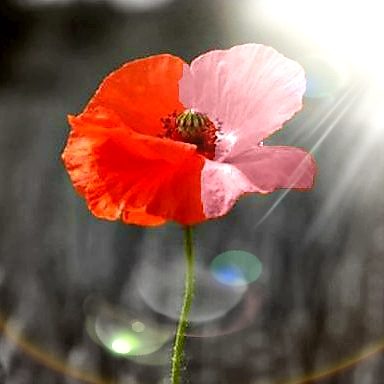

16 years ago, I lost a friend/family member to suicide. Today is her birthday, and I wanted to honour her with some memories and a discussion of the work I now do – namely suicide research and prevention. I am not arrogant enough to think that I could have done anything, but Ros continues to inspire me in my work for prevention of nurse suicide. As a nurse Ros cared for thousands of people throughout her career, but all to often those who are doing the caring need care in return, and don’t get it.

I grew up with Ros, we lived in the same house for a time. She was my sisters best friend and houseguest, who became a lodger and never really left. She told the Sunderland Echo in an interview in 2008:
“After a two-week visit to a friend in Sunderland I quickly decided that the friendliness and hospitality of the people up in the North East of England was my kind of society. The north-south divide does exist in my opinion – the north being a much more pleasant place to live.“ (Sunderland Echo: Legends of Sunderland Ros Warner, 2023)
When I moved in with my sister at the age of 12, Ros was already living there. The house was pretty full already with my sister, her husband, and their two infant children; one of which was practically a newborn with significant health support needs. Still my sister, hero that she is, also brought my mum and I into her home as we were struggling after my mum’s life partner, my birth mother, had suddenly up and left us. Realising that we were surviving on frozen meals and that I hadn’t been to school for nearly 3 years, my sister stepped in and saved us.

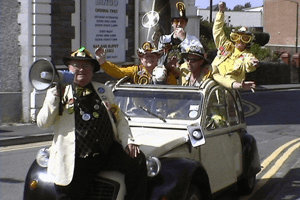
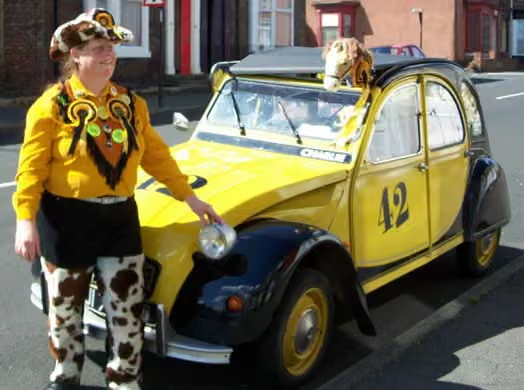
Of course that meant that Ros also had to be displaced. She even gave up her bedroom to give my mum a bedroom, first sleeping on a sofa before establishing the backroom as her den with a bed etc. She had few possessions, and always seemed poised for the next adventure. She only really seemed to prize her computer, on which she spent most of her time on the early versions of the internet; and her infamous Citroen 2CV “Brian”, painted bright yellow and black with the words “always look on the bright side of life” adorned on the back.
Ros was a colourful character in so many ways. She was a novelist (of some of the best worst books i’ve ever read), a gamer, a truck driver, a web designer, a nurse, a country and western fanatic, and a politician – standing for the Official Monster Raving Loony Party as “Mad Cow Girl”. An hilarious role, that she took very seriously.
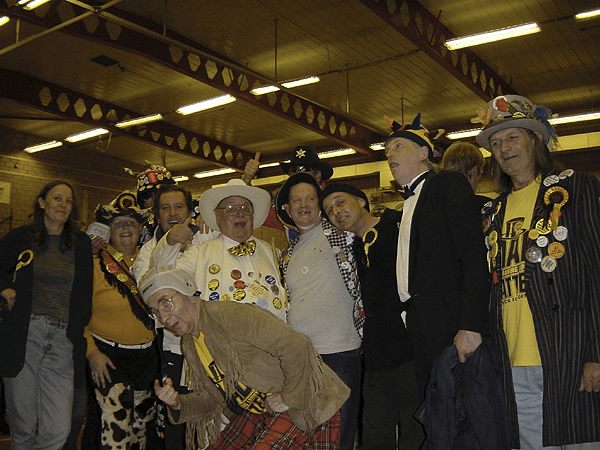
In 2005 she was quoted in Time Magazine in an article about the OMRLP being the last line of defence against hysterical politics.
That left the task of challenging Davis to candidates such as the OMRLP’s Mad Cow-Girl, aka Rosalyn Warner, a 47-year-old country-and-western fan, who has the distinctly unfunny job of working as a hospital nurse in an intensive care unit. Campaign photos show her wearing a bright yellow cowgirl outfit complete with cowhide hat and three OMRLP rosettes, but her manifesto includes a surprisingly cogent political argument: “I may be a Loony but I’m not mad enough to want dangerous people walking free in the name of political correctness. David Davis acted like a loony by throwing his toys out of his pram, so it was up to us to take a semi-serious platform, as he’d stolen our loony one” (Times Magazine, 2005)

There are a lot of things that defined my friend: her exumbrant nature, her sense of humour, her intellect, her sense of fun, her love of all things comedy, particularly Monty Python, and that ridiculous car which had bolts for door locks, prayer assisted breaking technology, and more holes and rust than floor.
I also have a lot of stories and memories of being endlessly teased by Ros as a teenager. Merciless and almost cruel at times, the onslaught of her wit helped to make me the wiseass I am today. In many ways, because I lived abroad and moved away from Sunderland, I didn’t know Ros as well in my adulthood, but she was a formative part of my teenage years, and I loved her dearly. When she died in 2010, the same year my eldest son was born, I was devastated.
Ros was many things, but she was also a nurse. An excellent nurse with years of experience and a love for the profession. It is partially because of Ros that I am constantly driving forward with my research into nurse suicide prevention. Nursing suicide is one of those public health issues that has sat in plain sight for too long. In England and Wales, suicide rates are now at their highest level since 1999, and among nurses the evidence is especially troubling. National data have shown that female nurses are at significantly higher risk of suicide than women in other occupations, with earlier ONS work estimating that risk as 23% higher.

A recent national update identified 621 working-age nurses in England who died by suicide between 2011 and 2022; most were women, around a third were aged 45–54, and self-poisoning was more common than in many other occupational groups. This is not a story about individual weakness. It is about a workforce repeatedly exposed to distress, responsibility, moral pressure, shift work, burnout, and organisational systems that are often very good at asking nurses to care, but much less good at caring for nurses.
My own work on nursing suicide has grown from a simple but uncomfortable question: what are we missing when we treat suicide only as an individual mental health event, rather than also as an occupational and social one? In my recent work, I have argued that occupational health has a central role in suicide prevention: not just identifying risk, but helping to build workplaces where distress can be disclosed safely and support is timely, meaningful, and human. That work now forms the basis of my Medical Research Foundation fellowship at the University of Glasgow, through the Crisis Narrative Project, which in turn is part of an overarching research project called RESUME: Research into Scottish nursing Suicide and Mental health Experience. Crisis Narrative brings together historical records, official data, survey research, oral history, and lived experience testimony from nurses, families, and occupational health professionals to better understand how suicidal distress develops, how it is narrated or silenced, and how prevention can move beyond warm words into practical, evidence-based action. The aim is straightforward: better evidence, earlier support, and fewer deaths.
Ros is very missed. I wish that I could share all that has happened since she died with her. I wish my sons could know her (although I wouldn’t let them in that ridiculous car). Our family has a large “mad cow girl” shaped hole in it. That’s why I think my work, our work here at the university of Glasgow, is so important. To try and prevent these holes in other families and friendship groups. To find ways to better support and prevent nurses who are struggling, and to establish better recognition and prevention mechanisms for those considering suicide. So thank you Ros. Thank you for all you did when you were with us, and thank you for inspiring me to try and help others. Happy Birthday Ros.


Leave a Reply