
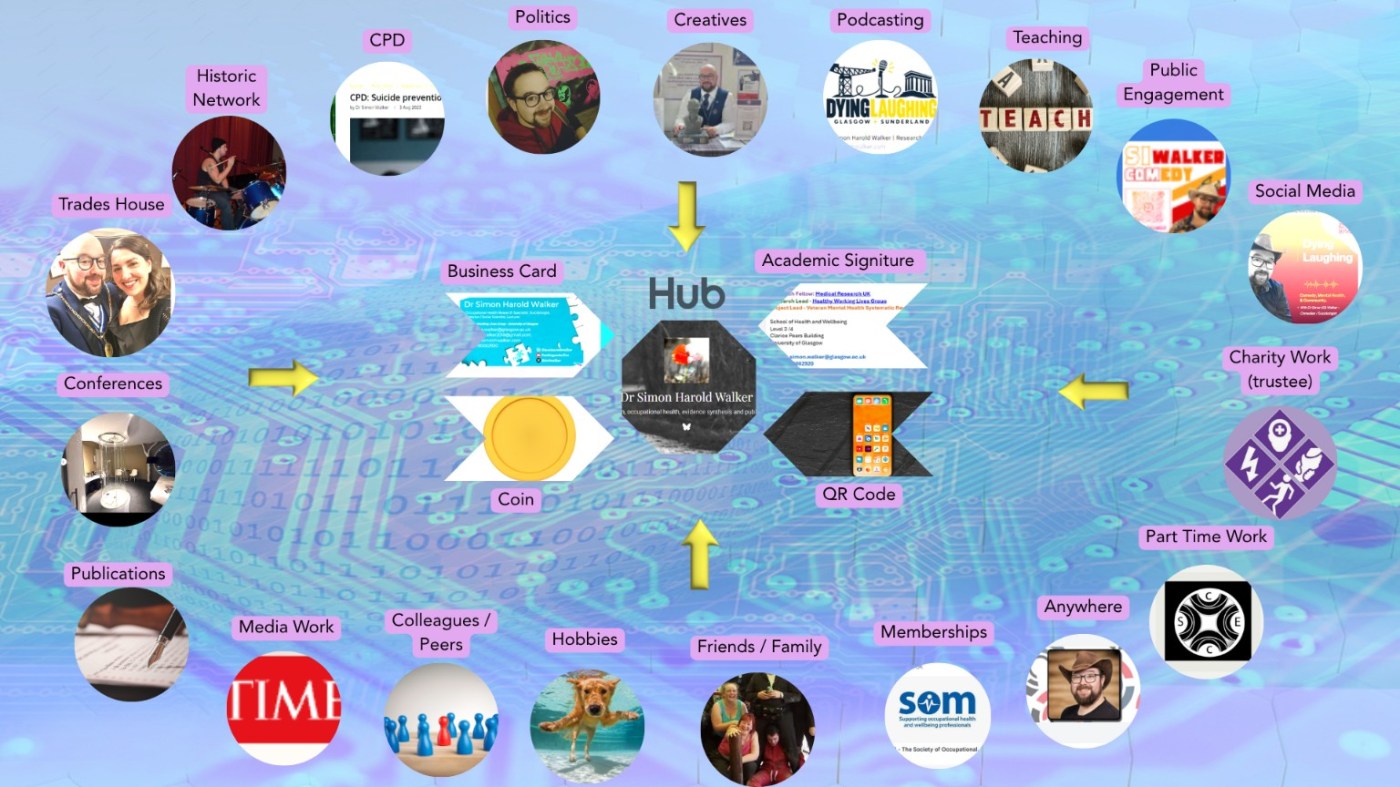
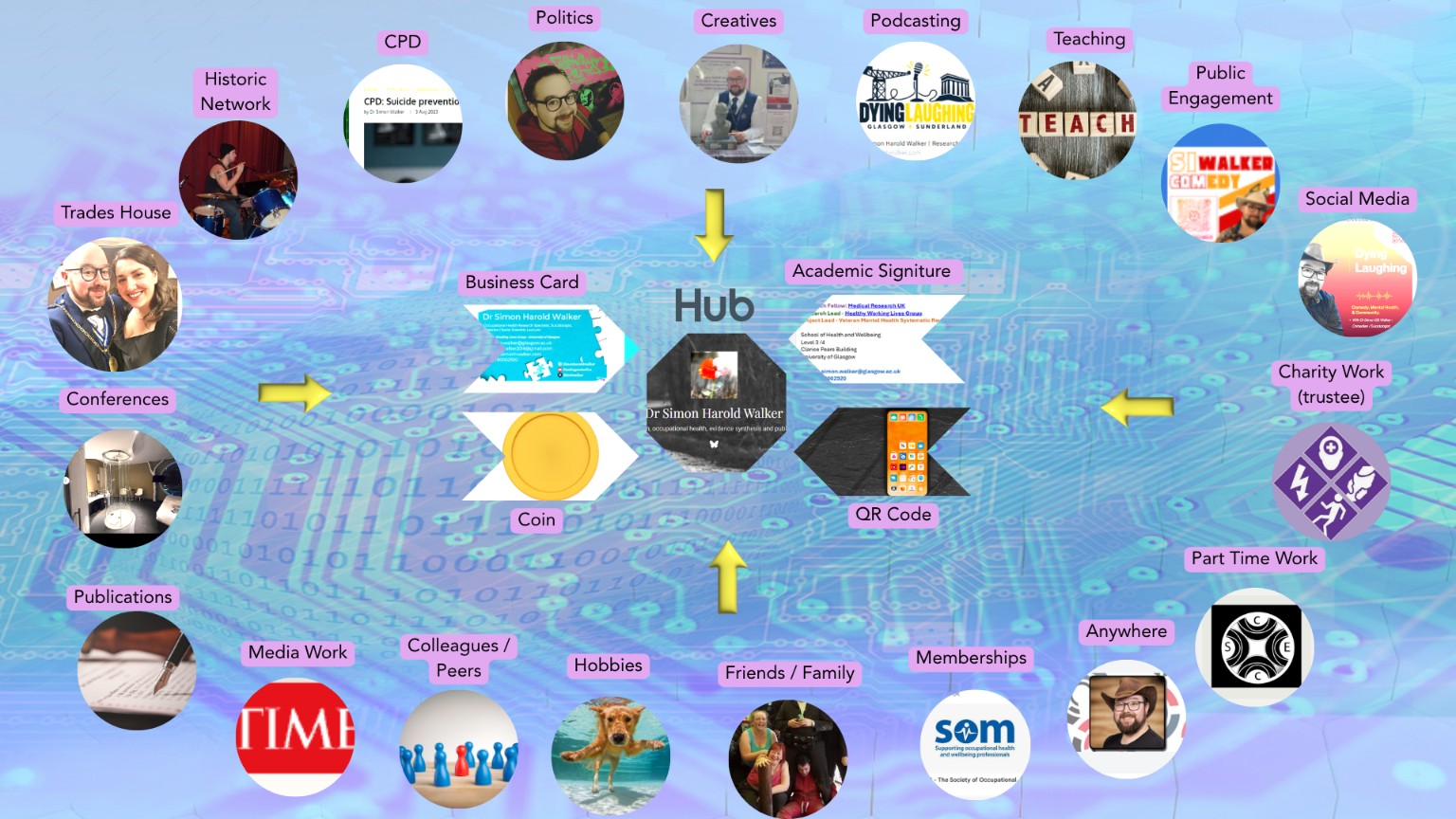
My networking approach: the website is the hub, and the outer circles show where connections begin. View the poster at full size.
Today I took part in networking training as part of my Medical Research UK fellowship. It gave me a useful opportunity to reflect on something I take seriously and think I am reasonably good at.
I enjoy meeting people. I am interested in what they do, how they arrived there and what matters to them. But I also put some thought into how those conversations happen and what happens afterwards. My approach is straightforward: always plan to network, and be ready to engage.
That means knowing how to introduce my work, being curious about someone else’s, and making it easy to stay in touch when we find something worth continuing.
Why networking matters to research
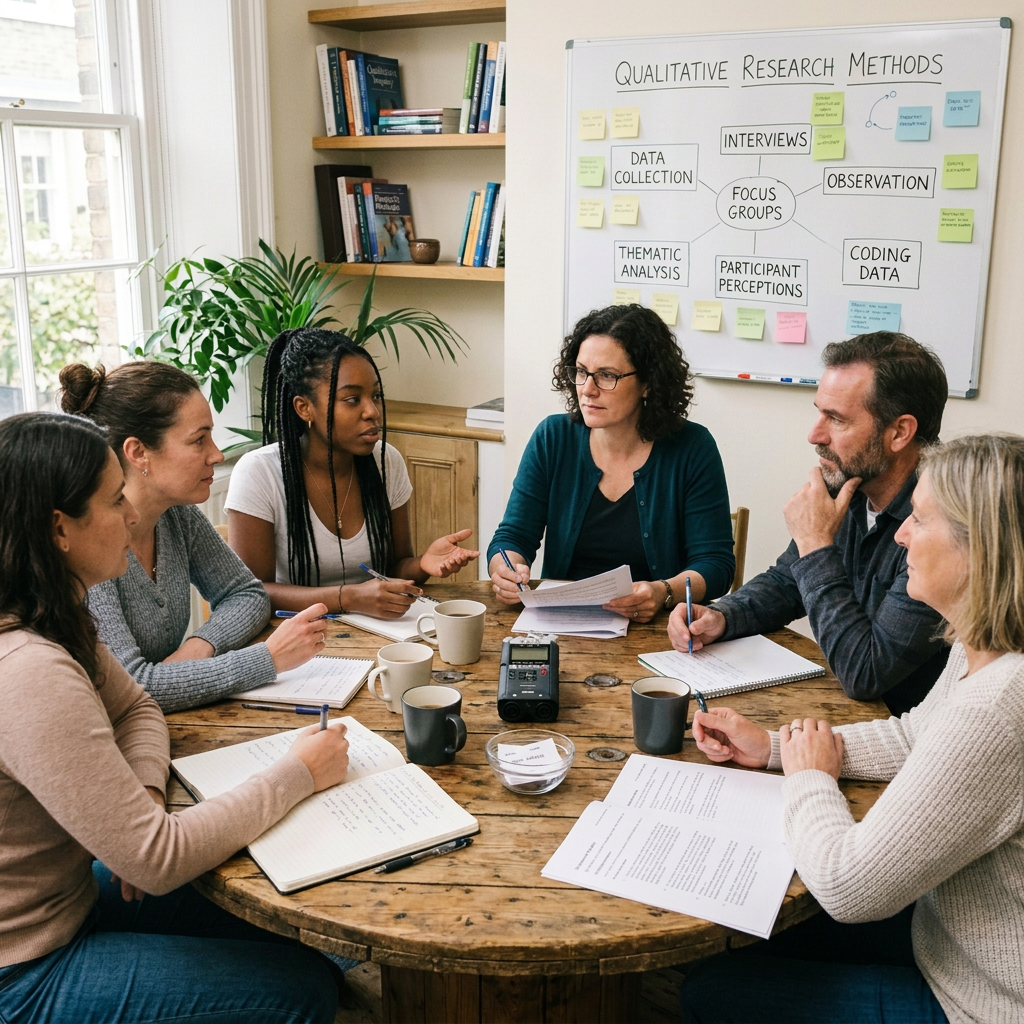
Research depends on being able to find and work with people whose knowledge complements our own. A conversation can introduce a different method, expose a weakness in an idea or connect us with someone facing the problem we are trying to understand. UK Research and Innovation places networking and knowledge exchange within its support for collaboration across universities, public services, business and civil society. [1]
There is also evidence that creating opportunities to meet can make a difference. In a field experiment at Harvard Medical School, researchers randomly assigned to the same structured information-sharing session were more likely to submit a joint funding application. That was one institutional setting and a particular funding opportunity, but it demonstrates how helping researchers find one another can support collaboration. [2]
For my own work in suicide prevention and occupational health, I want those conversations to include people with lived experience, practitioners, charities and community organisations. They bring knowledge and questions that I need to hear. A useful network should help us examine our assumptions and understand where our research might be useful.
There is a career dimension too. We need people who know our work, can offer advice and might think of us when an appropriate opportunity arises. I think the responsibility runs both ways: share useful information, make introductions and remember other people when opportunities come to you.
My website as a networking hub
The poster sets out my own approach. At the centre is my website, simonhwalker.com. It acts as a hub where someone can find out more about my research, writing and other activities, then decide whether to get in touch.
The four arrows represent the tools I use to direct people there: my business card, academic email signature, coin and QR code. Each provides a route back to me after the conversation. The practical point is to make that next step easy. A memorable meeting is more useful if the other person can find you again.
The outer circles show the different parts of my life through which I meet people. There are familiar research settings, including conferences, publications, teaching, professional development, colleagues and peers. Alongside them sit the Trades House, charity work, politics, creative activities, podcasting, media work and public engagement. Social media, memberships, part-time work, hobbies, friends, family and longstanding contacts all feature too.
That breadth matters to me. People encounter different parts of my work in different places. Someone who meets me through comedy may later be interested in my research, while someone I meet through research may have ideas about public engagement. The website gives those connections somewhere to continue.
Why networking can feel difficult
Walking into a room where everyone appears to know one another can be uncomfortable. You might worry about interrupting, talking too much, having nothing interesting to say or approaching someone more senior. Networking can also feel awkward when it seems to mean promoting yourself or asking for something. Cardiff University’s researcher guidance recognises that meeting new people can be draining or nerve-racking, and recommends approaches including preparation, listening and making an initial connection online. [3]
The setting deserves attention too. Can people hear one another? Is there somewhere quieter to talk? Can someone who needs to leave promptly still take part? We should ask those questions when organising events, and make introductions that help people join the conversation.
My advice is to choose a manageable starting point. Speak to one person about something that interests you. Ask a question after a session, arrange a short conversation beforehand or send a thoughtful email afterwards. Being outgoing is one way to meet people. Taking an interest and giving someone space to speak are skills we can all practise.
My six golden rules of networking
1. Be prepared
Before an event, look at the programme and think about who you would like to meet and why. Have a short, clear explanation of what you do and why it matters. Give the other person room to ask a question before delivering the director’s cut of your CV.
Check the practical details as well. Does your QR code work? Is your website current? Can you easily share your contact details? Preparation also means thinking about what you could offer, whether that is a useful paper, an introduction or relevant experience.
2. Any opportunity can be an opportunity
Keep an open mind about where a useful conversation might begin. A training session, a charity event, a shared hobby or a conversation with someone outside your discipline may reveal a connection you had never considered.
Pay attention to the person and the setting. There is no need to turn every social occasion into a discussion about work. Being ready to engage includes recognising when someone is interested, when they are busy and when a conversation should simply be enjoyed for what it is.
3. Make a positive impression
Be approachable, considerate and honest about your work. Explain it clearly, show enthusiasm and respect the other person’s time. Treat students, support staff, community members and senior academics with the same courtesy.
Make room for others. Introduce someone who is standing alone, invite a quieter person into the discussion and avoid monopolising the conversation. You can leave a positive impression by helping somebody else feel welcome.
4. Be interested in others
Ask questions you actually want answered. What are they working on? What brought them to the event? What are they finding difficult or exciting? Listen closely enough to ask a follow-up question about what they have said.
Look for ways to be useful without immediately expecting something in return. A relevant introduction or a resource sent afterwards can be a good beginning. You also need to allow for conversations that lead nowhere professionally. People are worth talking to without having to justify their place in your next funding application.
5. Secure contact details
If you both want to continue the conversation, ask how best to stay in touch. That might be email, LinkedIn or another route they prefer. Offer your own details as well.
Make a brief note afterwards about where you met, what you discussed and anything you promised to send. It gives your follow-up a purpose and saves you staring at a name three weeks later, trying to remember which conversation belonged to it.
6. Always follow up
When you agree to stay in touch, follow through while the conversation is still fresh. Remind the person where you met, mention something specific you discussed and send whatever you promised. If there is a useful next step, suggest it clearly.
Keep the message proportionate. Sometimes a thank-you and a link are enough. Sometimes it makes sense to arrange another conversation. Give people time to respond and respect it if they do not. Following up is about keeping your word and giving the connection a chance to develop.
Making room for the next conversation
Today’s training gave me space to look at how I already approach networking and where I can be more deliberate. The poster helps me see the range of people I meet and the practical steps that can keep a conversation going.
For me, networking is part of doing research well. It means making time for people, being willing to learn from them and doing what I said I would do afterwards. Always plan to network, and be ready to engage. Then remember to send the email.
Sources
[1] UK Research and Innovation. Supporting collaboration. Read source
[2] Boudreau, K.J., Brady, T., Ganguli, I., Gaule, P., Guinan, E., Hollenberg, A. and Lakhani, K.R. (2017). A field experiment on search costs and the formation of scientific collaborations. The Review of Economics and Statistics, 99(4), pp. 565–576. DOI 10.1162/rest_a_00676
[3] Cardiff University. Networking and social media. Career Directions for Researchers. Read source


Leave a Reply