
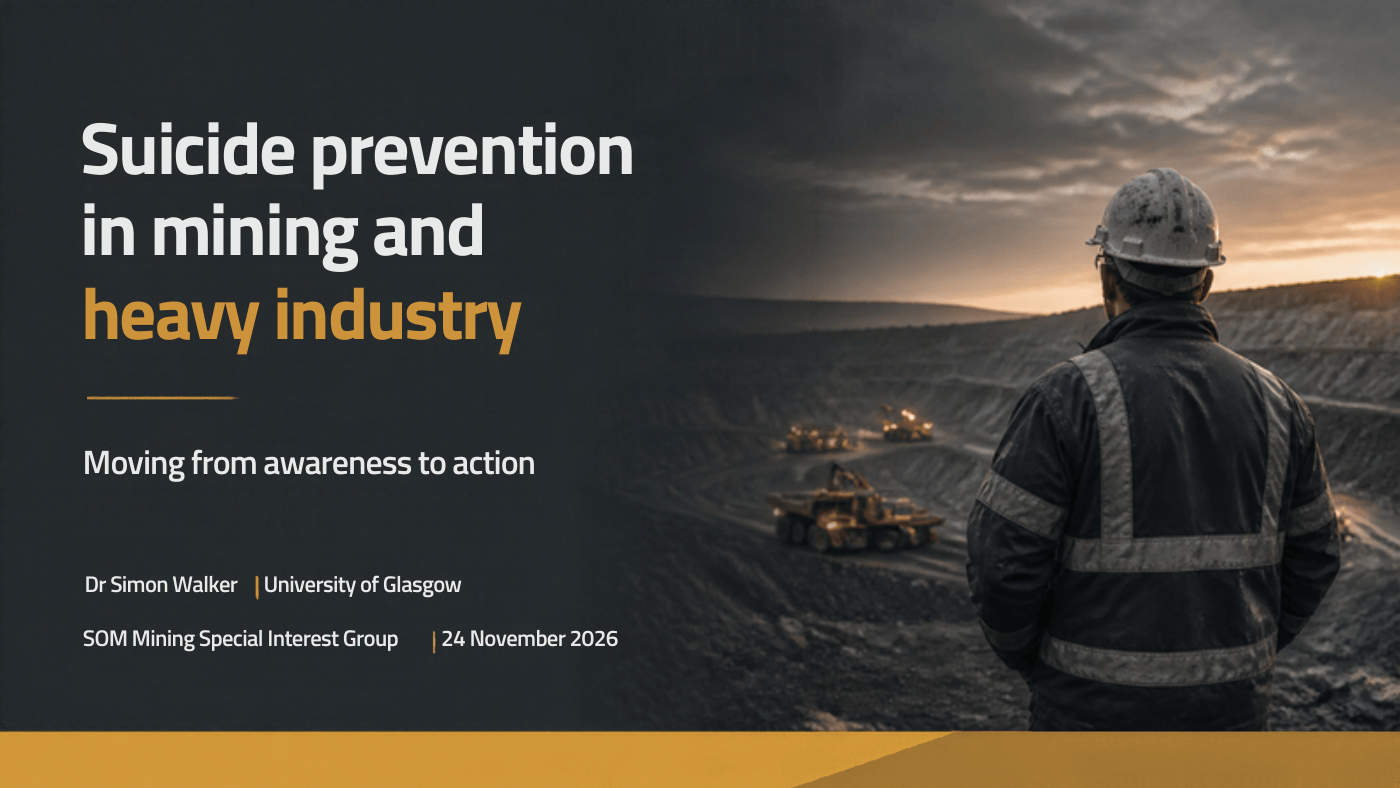
This morning I had the opportunity to speak to the Society of Occupational Medicine’s Mining Special Interest Group about suicide prevention in mining and heavy industry. It was a welcome opportunity to bring together two areas that are central to my work: understanding suicidal crisis and considering what occupational health can do to support people at work.
Our discussion included the very different environments in which mining takes place, from large formal workplaces to artisanal and small-scale mining. The question running through the presentation was a practical one: how do we make prevention and support meaningful for people whose working lives, communities and access to services may look very different?
Download the presentation: Suicide prevention in mining and heavy industry (PDF, 21 MB). The slides include references and are available for colleagues to revisit and share.
Work, health and suicidal crisis
Work can provide income, purpose, identity and connection. It can also bring pressures that interact with experiences outside work. Physical injury, pain, financial insecurity, fatigue, isolation and difficulty accessing help may all be relevant to a person’s circumstances, although none tells us on its own whether someone will experience a suicidal crisis.
One of the strengths of occupational health is its ability to consider that relationship between the person and the conditions in which they work. The opportunity is to look at what can be changed in the workplace, alongside what support an individual might need.
What does the evidence tell us?
There is relevant evidence from mining in Africa, although the settings and outcomes differ. A historical study of South African platinum miners reported suicide deaths in a cohort employed at one large mine between 1992 and 2008. Its findings cannot be applied automatically to today’s mining workforce or to artisanal miners, but they demonstrate the value of examining occupational data with care.
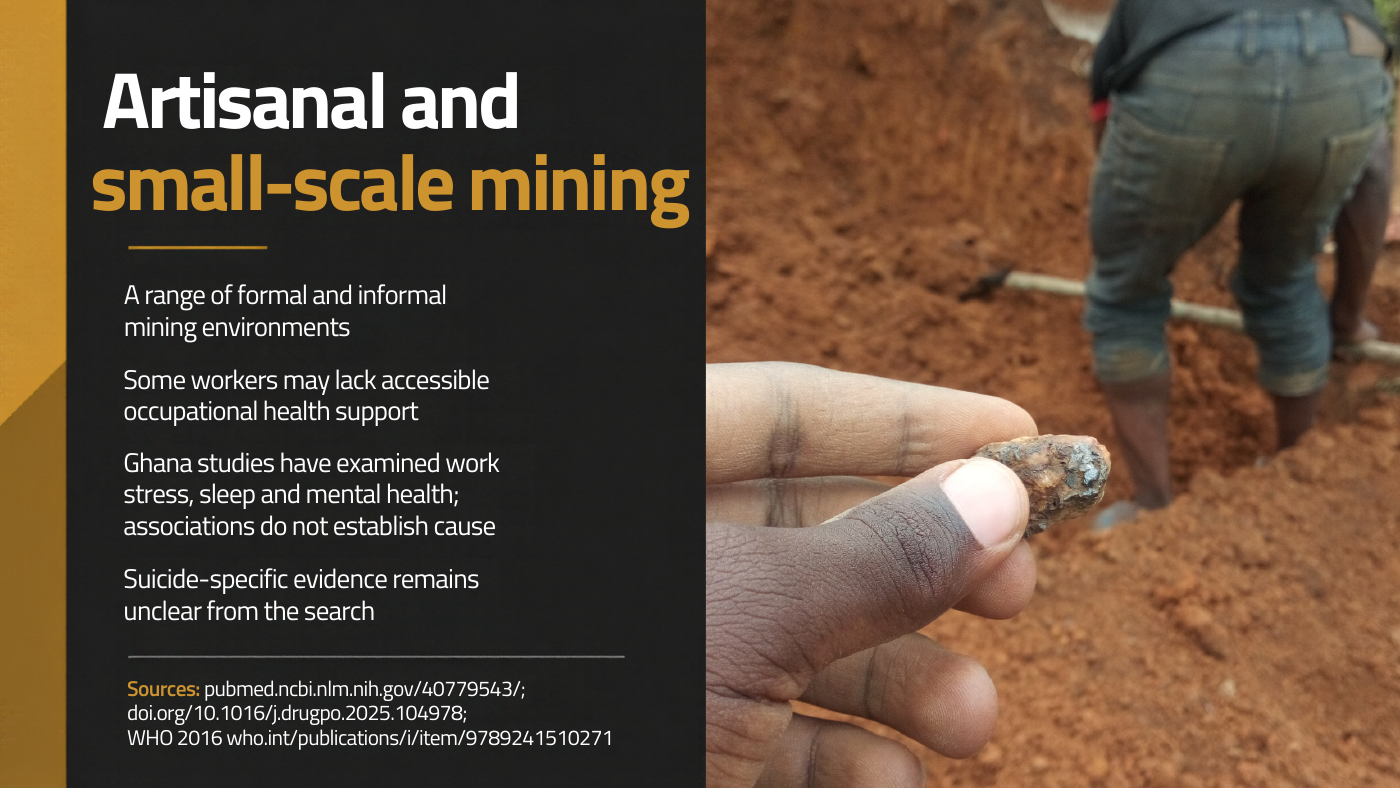
In Ghana, research with artisanal and small-scale miners has examined associations between work stress and depressive symptoms. Other studies have explored work-related stress and sleep and self-rated health. Research in larger Ghanaian gold mines has also identified associations between psychological distress and aspects of working conditions.
We need to be precise about what those studies can tell us. Psychological distress and depressive symptoms are not the same as suicidal thoughts, suicide attempts or suicide deaths. Cross-sectional studies can identify associations, but cannot establish that one factor caused another. Some of the Ghanaian studies may also draw on overlapping samples, something to check when considering the evidence as a whole.
That leaves questions about suicide-specific evidence in artisanal and small-scale mining. It also gives us a reason to keep looking, and to work with mining communities to understand what the available evidence means in context.
Where occupational health can make a difference
Occupational health brings together knowledge of work, health and prevention. It can help identify avoidable pressures, support people living with health conditions, advise on adjustments, and help organisations think about what happens when a worker needs support.
In a large workplace, that might include working with managers, safety representatives and workers to consider fatigue, psychological health, confidentiality and routes to care. In artisanal and small-scale mining, the starting point may be different. There may be no single employer or established occupational health service, so partnerships with miners, communities, local health workers and other organisations become particularly important.
A service needs to be more than available on paper. Can people reach it? Is it affordable? Is it offered in a language they understand? Do they trust it, and can they use it without sacrificing income? These are questions to explore with the people concerned, rather than assumptions to make on their behalf.
From awareness to action
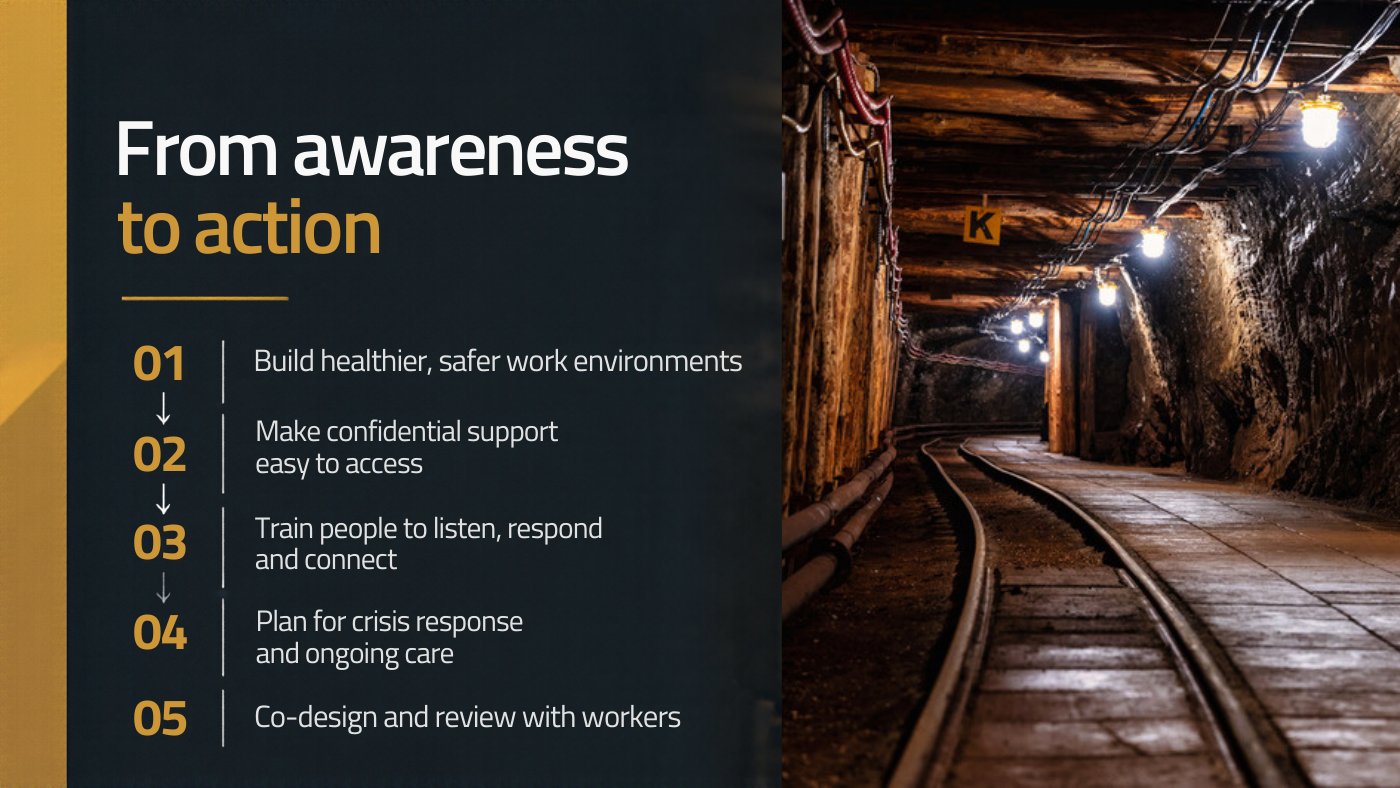
We considered the potential role of approaches such as COMPASS, VitalCog and ASIST in supporting awareness, conversations and connections to help. These offer useful ideas, but an approach developed for one setting needs careful consideration and adaptation before it is introduced elsewhere. Training is part of a wider response that includes working conditions, accessible services and what happens after someone asks for help.
I also introduced SPACE, a resource I am developing to support the first conversation when someone discloses suicidal thoughts. It remains an unvalidated research prototype, rather than a clinical tool or a substitute for appropriate care.
My thanks to Will and the Society of Occupational Medicine’s Mining Special Interest Group for the opportunity to contribute. The connection between suicide prevention and occupational health offers a positive opportunity: to bring together evidence, professional expertise and the knowledge of workers and communities to create support that fits their circumstances.
How can we make suicide prevention and occupational health support accessible across mining, including to those working beyond formal employment structures?
I would welcome conversations with anyone interested in research or collaboration in this area. You can get in touch at simon.walker@glasgow.ac.uk.
Further reading
- Lim MSC and colleagues (2011), Unnatural deaths in South African platinum miners, 1992–2008.
- Asare-Doku W and colleagues (2021), Mental health and mining: the Ghanaian gold mining story.
- Nyaaba E and colleagues (2025), Work-related stress and sleep problems among small-scale miners in Ghana.
- Nyaaba E and colleagues (2025), Work-related stress and self-rated health among artisanal and small-scale miners in Ghana.
- Nyaaba E and colleagues (2026), Work stress and depressive symptoms among artisanal miners in Ghana.
- Hallett N and colleagues (2024), Workplace interventions to prevent suicide: a scoping review.


Leave a Reply